Your Right to Purity’ is the philosophy with which the Late Gourango Chandra Ghosh established the Annapurna Group in 1952. He firmly believed that it was the company’s duty to look after its customers’ health and well-being.
Your Right to Purity’ is the philosophy with which the Late Gourango Chandra Ghosh established the Annapurna Group in 1952. He firmly believed that it was the company’s duty to look after its customers’ health and well-being.
Agro Based Food Processing Industries in India: Key Growth
16 Mar 2026
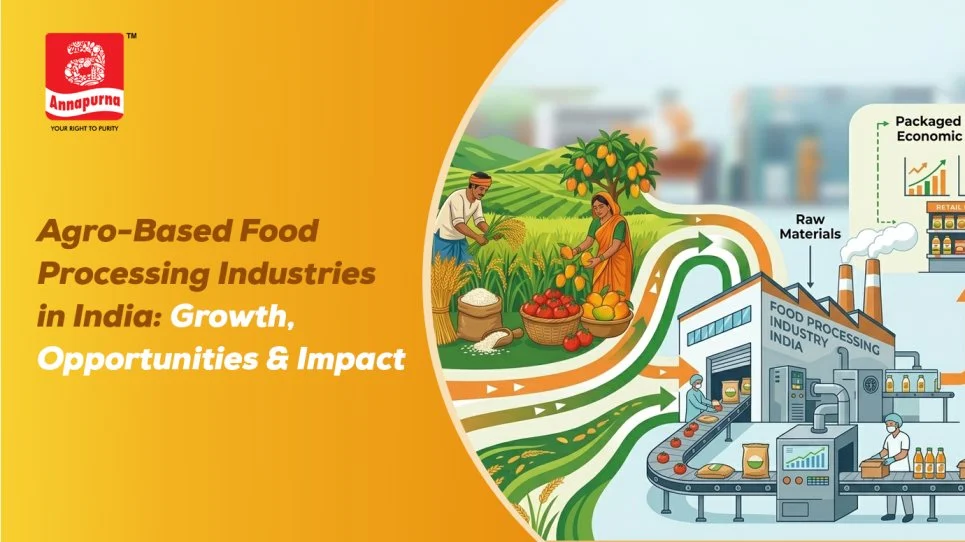
India’s food economy is deeply connected to its agricultural sector. As consumer preferences change and the demand for packaged, hygienic food continues to rise, agro based food processing industries in India play an increasingly important role. They help connect farmers with consumers while improving food availability, reducing waste, and creating value from agricultural produce.
Today, the agro and food processing industry goes far beyond basic preservation and milling. It includes modern manufacturing, quality control, cold-chain logistics, and advanced processing methods that help food products reach consumers safely and efficiently.
India’s agricultural diversity supports a wide range of food processing activities. From grains and edible oils to dairy products and packaged foods, agro-based manufacturing helps meet the growing needs of consumers across the country.
Some of the key benefits of agro-based food processing include:
Reducing post-harvest losses
Supporting stable farmer incomes
Creating shelf-stable food products
Strengthening organised food supply chains
As a result, the role of an agro industrial company extends beyond manufacturing. Companies today focus on responsible sourcing, operational efficiency, and compliance with food safety standards.
Many regions in India are developing food processing clusters near agricultural hubs. These clusters reduce the time between harvesting and processing, helping preserve freshness and minimise wastage.
Locating processing facilities close to farms also improves logistics. Instead of transporting raw produce over long distances, companies can process products locally and distribute finished goods through wider retail networks.
Value Addition: Turning Agricultural Produce into Consumer Products
One of the biggest advantages of the agro and food processing industry is its ability to create value-added products from raw agricultural materials. This process improves shelf life, increases market reach, and makes products more convenient for consumers.
For example:
Fruits can be processed into juices, jams, and preserves.
Milk can be converted into a variety of dairy products.
Grains can be transformed into packaged staples and ready-to-cook foods.
Value addition benefits everyone in the supply chain. Farmers gain access to more stable markets, while manufacturers can build reliable product portfolios that meet consumer demand.
Consumer expectations have also changed over time. Today, people look for food products that are hygienic, safe, and consistent in quality. To meet these expectations, manufacturers continue to invest in modern processing technologies, food safety certifications, and improved packaging solutions.
Why Agro-Based Processing Matters for FMCG Growth
The success of food and FMCG brands depends heavily on strong agro-processing infrastructure. Without consistent raw materials and reliable manufacturing systems, companies often struggle to scale their operations.
This is why many of the best agro industries in India focus on:
Structured sourcing networks
Standardised manufacturing processes
Strong quality control systems
Efficient regional and national distribution
These practices help ensure that agricultural products are transformed into consumer-ready goods without compromising quality or safety.
The growth of organised retail and e-commerce has further increased the need for dependable supply chains. Food manufacturers must maintain steady production while ensuring product availability across both traditional and modern retail channels.
Strong agro-processing capabilities therefore form the foundation of sustainable FMCG growth.
Integrated Players in the Agro-Food Ecosystem
Many modern agro-based food processing companies now operate through integrated business models. These companies manage multiple stages of the value chain, including sourcing, processing, and distribution.
This approach improves efficiency and gives companies greater control over product quality.
Companies like Annapurna Group follow this integrated model by aligning agro sourcing with food and dairy processing operations. Such organisations contribute to a more organised and reliable agro-food ecosystem.
Integrated operations also help manufacturers build stronger relationships with farmers and suppliers. This allows them to maintain consistent sourcing standards while encouraging responsible agricultural practices.
Better coordination across the supply chain ultimately strengthens consumer trust and operational reliability.
The Growing Role of Technology in Agro Processing
Technology is transforming agro based food processing industries in India. Modern facilities now use automated production systems, advanced storage solutions, and digital quality monitoring tools to improve efficiency.
These advancements help companies achieve:
Higher production efficiency
Better food safety compliance
Reduced processing losses
Improved packaging and shelf life
Digital supply chain management is also becoming increasingly important. By using data and demand forecasting tools, manufacturers can plan production more effectively and reduce operational inefficiencies.
As technology adoption continues to grow, it is helping strengthen India’s overall food processing ecosystem.
The Future of Agro and Food Processing in India
The future of the agro and food processing industry looks promising. As India’s population grows and consumers increasingly choose branded food products, demand for processed food will continue to expand.
Future-ready companies will focus on:
Investing in modern manufacturing facilities
Building stronger farmer partnerships
Maintaining high food safety standards
Creating scalable and responsible operations
Sustainability is also becoming a major priority. Many companies are exploring ways to reduce waste, improve energy efficiency, and adopt environmentally responsible packaging solutions.
Agro based food processing industries in India will continue to play a vital role in supporting rural development, strengthening supply chains, and meeting the country’s growing food needs.
As the industry evolves, companies that combine efficient manufacturing with responsible sourcing practices will be well positioned to shape the future of India’s food sector.



 16 Mar 2026